First, thank you for so many generous financial gifts in support of polio eradication. More than 25% of my fundraising goal has now been reached, and there are still seven weeks left.
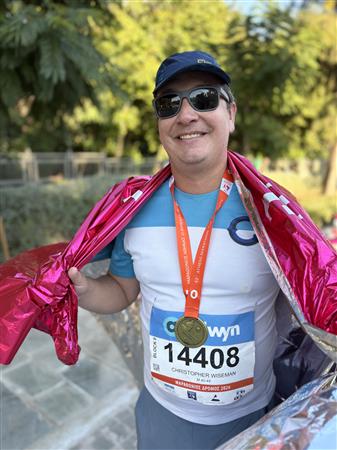
Eight days ago, I completed the Athens Marathon. Of the 14 marathons I have run, this was the marathon for which I felt the least prepared.
After completing the Sydney Marathon in August, fatigue lingered. Running resumed after a few weeks, but no runs longer than 10 miles were completed. Usually, the final eight weeks before a marathon, I include four to six runs of more than 12 miles in my training.
A little bit about the Athens Marathon
The morning began with a 6:30 AM bus ride to the city of Marathon. After arriving around 7:30 AM, there was time to relax and prepare for the 9:06 AM start. The course began beautifully, taking me past olive orchards and groups of families cheering along the way, followed by spectacular views of the water and rolling hills. At mile 6, a gradual incline began and continued until mile 19. Having completed the Big Sur Marathon three times and run plenty of hills in San Francisco, I thought I knew what to expect. This was harder. By mile 19, my body felt worn out.
Getting past the hardest part of the course was a relief, but the descent toward Athens still included plenty of rolling hills. Walking became necessary on some of the inclines, particularly as temperatures continued to rise. By mile 24, while running through the city center of Athens, my pace had slowed considerably. Most of my friends and family probably could have walked faster than I was running.
As the crowds grew bigger, the finish line was getting closer. Ahead was the entrance to the Panathenaic Stadium, a site with an extraordinary history spanning more than 2,300 years. The original stadium was built around 330 BC to host the Panathenaic Games, an important religious and athletic festival held in honor of the goddess Athena. It was later rebuilt in marble around 144 AD, gradually fell into disuse, and was abandoned for many centuries. Following its rediscovery in 1869 and extensive restoration, it became the finishing venue for the marathon at both the 1896 and 2004 Olympic Games.


Entering this stadium brought out so many emotions. The stands were filled with spectators, including my husband Eric, his cousin Lori, and many members of the Morgan Hill Chamber of Commerce — a story for another day.
During the final 100 meters, my calf muscles began to tighten, which was one of my biggest concerns. There was one thought in my head: there was no way I was going to walk. I looked ahead and kept running. Within moments, I crossed the finish line, and my recovery began. After five days of rest and walking, running felt comfortable again. The first run was the symbolic distance of 2.62 miles, representing 10% of a marathon. The result? I felt energized.
The Purple Pinkie Challenge
As part of the Purple Pinkie Challenge, I encourage all of you to participate in at least one of the following activities as we approach the holiday season:
- Run or walk 2.62 miles.
- Make a gift of at least $26.20 to help eradicate polio.
- Paint your pinkie purple to help start a conversation about polio.
My personal challenge continues with a run in a new city each week and more conversations about polio eradication. This week though, I will focus on continued recovery, gradually increasing from one run to two.
 Feeling great and looking forward to rebuilding running fitness. The next race will be the Hot Chocolate 15K in San Francisco in early January. Everyone is welcome to sign up and join me.
Thank you again for your continued encouragement and generosity. Every contribution and every conversation brings us one step closer to a polio-free world.